
Women Have Always Worked, an edX Course Exploration, 31-40
Video Gallery
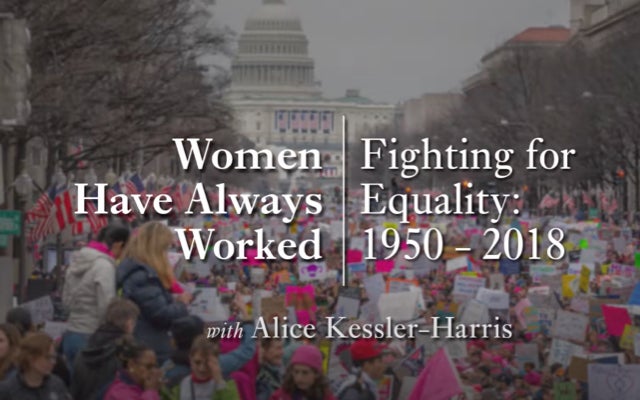
Women Have Always Worked: Fighting for Equality: 1950–2018.
An exploration from an online edX course.

The following are video previews from the edX course “Women Have Always Worked” presented by Alice Kessler-Harris and Columbia University.
Women Have Always Worked: Fighting for Equality: 1950–2018.
An exploration from an online edX course.
LABOR: Studies in Working-Class History is the official journal for the Labor and Working-Class History Association (LAWCHA), and is housed at the Kalmanovitz Initiative for Labor and the Working Poor at Georgetown University. A subscription to LABOR is available through membership in LAWCHA.
In this oral history website Brooklyn College students narrate two historical episodes: their experiences of working on farms during World War II, and the events surrounding the suspension of the Vanguard, the student newspaper in a postwar McCarthy era climate. The edited testimony is accompanied…
Lowell built on the advances made in the British textile industry, such as the use of the power loom, to industrialize American textile production. He was the first factory owner in the United States to create a textile mill that was vertically integrated.
This encyclopedia appeared first as a published volume in 2004, but the published and electronic versions evolved together, part of an integrated vision of a new kind of historical encyclopedia. It includes thousands of entries, historical sources, and special features. One special feature, a map…
On May 8, 1970, the Dow Jones Industrial Average dropped five points to finish at 717, in the slowest day of trading in months. In the streets outside the New York Stock Exchange, however, chaos erupted: at noon, hundreds of construction workers arrived on Wall…
Women Have Always Worked: Fighting for Equality: 1950–2018.
An exploration from an online edX course.
In August 1981, over 12,000 members of the Professional Air Traffic Controllers Organization (PATCO) walked off the job after contract negotiations with the Federal Aviation Administration (FAA) broke down.
“Wildcat” strikes, like the one that teachers used effectively in West Virginia in February/March of this year, are when union members walk off the job despite the wishes of their leadership. By definition, they are something uncontrollable and spontaneous.
APWU remembers the Great Postal Strike of March 1970. For more background on the successful wildcat strike that earned postal workers the right to bargain collectively for better pay and benefits.