
Women Have Always Worked, an edX Course Exploration, 91-98
Video Gallery
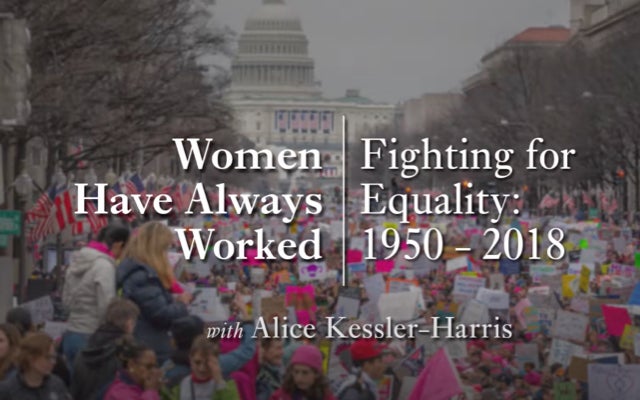
Women Have Always Worked: Fighting for Equality: 1950–2018.
An exploration from an online edX course.

The following are video previews from the edX course “Women Have Always Worked” presented by Alice Kessler-Harris and Columbia University.
Women Have Always Worked: Fighting for Equality: 1950–2018.
An exploration from an online edX course.
Women Have Always Worked: Fighting for Equality: 1950–2018.
An exploration from an online edX course.
Part of the City University of New York, the American Social History Project is a recognized leader in effective, engaging history education. Who Built America Badges for History Education is designed for Grade 7-12 teachers
A gallery of photos to explore.
In 1820 Lowell, known as East Chelmsford, MA at the time, had a population of 200 and was a farming community. Thirty years later, the population had grown to 33,000 and one could find 32 textile mills in existence there. Lowell was an ideal location for these mills because it was located near the Merrimac River. The river supplied the water necessary to run these factories.
The Iowa Labor History Oral Project (ILHOP) is an innovative statewide initiative to document Iowa’s rich labor and working class history through the collection and preservation of oral histories. A joint project of the Iowa Federation of Labor (AFL-CIO), the University of Iowa Labor Center,…
The Flint sit-down strike, which started on Dec. 30, 1936, represented a shift in union organizing strategies from craft unionism (organizing white male skilled workers) to industrial unionism (organizing all the workers in an industry). The sit-down strike changed the balance of power between employers and workers.
In 2012, the Chicago Teachers Union (CTU) issued the groundbreaking report, The Schools Chicago’s Students Deserve. The report provided a counter-narrative to ideas popular among corporate education reformers (or de-formers, as some like to say).
In 2007, the National Education Association celebrated its 150th year. Over this time, NEA has been a driving force in education at all levels.
“Culture becomes not a haven of ideas or a fixed state of experience but a social imaginary erupting out of a storied cultural real.” (Stewart 1996, 63-4)
I remember the day when my father, a West Virginia University professor, accompanied some of his students to Charleston for Undergraduate Research Day at the Capitol in February 2018.