
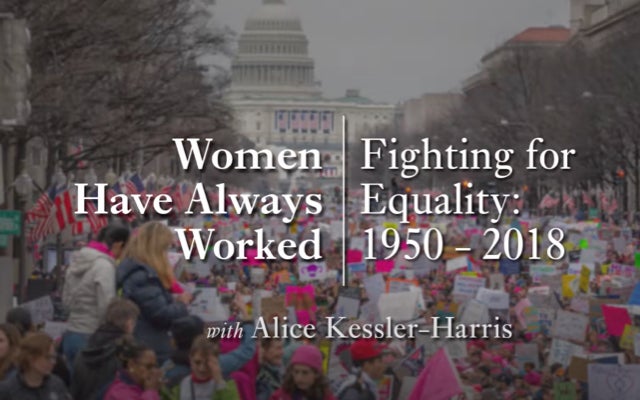
Women Have Always Worked, an edX Course Exploration, 1-10
Video Gallery
Women Have Always Worked: Fighting for Equality: 1950–2018.
An exploration from an online edX course.

The following are video previews from the edX course “Women Have Always Worked” presented by Alice Kessler-Harris and Columbia University.
Introduction to Course 4 | Fighting for Equality: 1950–2018
Women Have Always Worked: Fighting for Equality: 1950–2018.
An exploration from an online edX course.
Though it’s a relatively recent field of study, women’s history is inscribed across all of the Harvard Library holdings gathered since 1638. By examining those holdings afresh and querying them in a new and feminist light, the curators of the Women Working collection have aggregated…
Voces from La Planta centers the voices of meatpacking workers across California, Minnesota, Colorado, Mississippi, and Washington. Workers whose labor sustains the nation, yet whose lives are too often made invisible.
The members of United Teachers Los Angeles believe that neighborhood public schools should serve as the essential anchors of our communities. As educators we see first-hand what students need in our classrooms, our school, our clinics, and our neighborhoods, and we deal with the issues that too often prevent those needs from being met.
A gallery of photos to explore.
The CIO transformed American labor and American politics. Defying the American Federation of Labor’s commitment to craft unionism, the Committee for Industrial Organization was established in 1935 by leaders of the United Mine Workers and other AFL unions who embraced industrial union organizing strategies.
Near closing time on March 25, 1911, a fire broke out at the Triangle Waist Factory in New York City. Within 18 minutes, 146 people were dead as a result of the fire. This site includes original sources on the fire held at the ILR…
This collection presents 470 interview excerpts and 3882 photographs from the Working in Paterson Folklife Project of the American Folklife Center at the Library of Congress. The four-month study of occupational culture in Paterson, New Jersey, was conducted in 1994. The documentary materials presented in…
The Lawrence Textile Strike was a public protest mainly of immigrant workers from several countries, including Austria, Belgium, Cuba, Canada, France, England, Germany, Greece, Ireland, Italy, Lithuania, Netherlands, Norway, Poland, Portugal, Russia, Scotland, Spain, Syria, and Turkey. According to the 1910 census, 65% of mill workers (many of whom eventually struck) lived in the United States for less than 10 years; 47% for less than five years.