
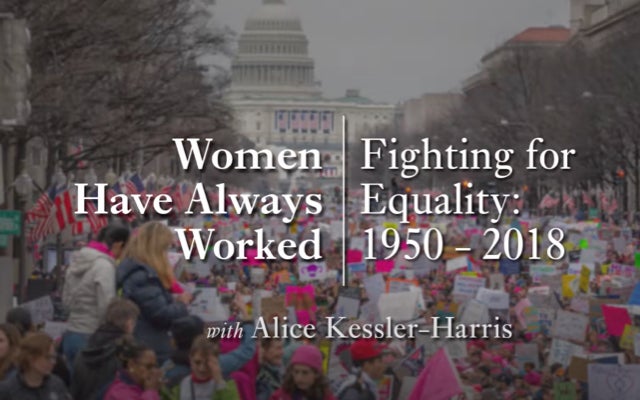
Women Have Always Worked, an edX Course Exploration, 21-30
Video Gallery
Women Have Always Worked: Fighting for Equality: 1950–2018.
An exploration from an online edX course.

The following are video previews from the edX course “Women Have Always Worked” presented by Alice Kessler-Harris and Columbia University.
Women Have Always Worked: Fighting for Equality: 1950–2018.
An exploration from an online edX course.
This article examines both the Bargaining for the Common Good (BCG) contract campaigns that have emerged among teachers unions in the years since the Great Recession and the #RedforEd strikes and mobilizations of 2018.
Designed for both high school and college classrooms, History Matters helps students actively interpret evidence about the lives of ordinary Americans. It contains descriptions of and links to more than 1000 websites and first-person primary source documents, guides for analyzing historical evidence, classroom activities, and…
The Boott Cotton Mills Museum gives a snapshot of what is was like to work in New England cotton mills in the 1800s. The Museum, once Boott Mill #6, was originally owned by Kirk Boott, an industrialist who was responsible for much of the early urban planning that shaped Lowell’s industrial and residential landscape.
The Bracero History Archive collects and makes available the oral histories and artifacts pertaining to the Bracero program, a guest worker initiative that spanned the years 1942-1964. Millions of Mexican agricultural workers crossed the border under the program to work in more than half of…
The National Domestic Workers Alliance (NDWA) works for the respect, recognition, and rights for more than 2.2 million nannies, housecleaners, and home care workers who do the essential work of caring for our loved ones and our homes.
When Teachers Mobilize Oral Histories
The Lowell mill girls were young female workers who came to work in industrial corporations in Lowell, Massachusetts, during the Industrial Revolution in the United States.
From early in the 19th century through recent years, the Mahoning Valley has drawn new migrants and immigrants seeking economic opportunities and new homes. As those families settled in the area, they created the diverse cultural mix of our present day community. They brought new…
The Southern Historical Association was organized on November 2, 1934 with the idea of promoting an “investigative rather than a memorial approach” to southern history. Its objectives are the defense of history education and historical thinking in the South; the promotion of rigorous research in southern history; the collection and preservation of the South’s historical records; and the encouragement of state and local historical societies in the South.