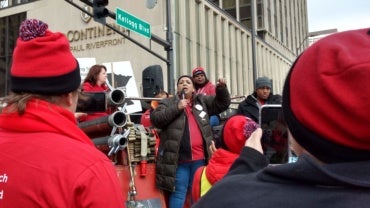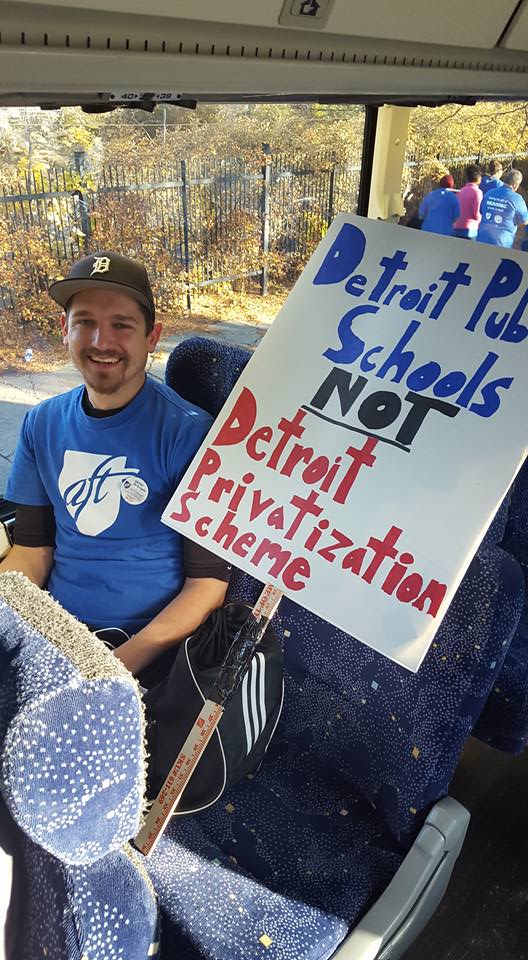

2015 Lansing March, Joel Berger Collection
Photo Gallery
A gallery of photos to explore.

A gallery of photos to explore.
Not long ago, in the pages of this journal, I argued a number of propositions about the current state of historical research in the area of teacher unionism. One of those propositions was that a full explanation of the history of teacher union activity in the U.S.A. quite likely would require a three-pronged analysis involving the local, state, and national arenas.
The Lowell mill girls were young female workers who came to work in industrial corporations in Lowell, Massachusetts, during the Industrial Revolution in the United States.
This article examines both the Bargaining for the Common Good (BCG) contract campaigns that have emerged among teachers unions in the years since the Great Recession and the #RedforEd strikes and mobilizations of 2018.
Women and Social Movements in the United States, 1600-2000, is a resource for students and scholars of U.S. history and U.S. women’s history. Organized around the history of women in social movements in the U.S. between 1600 and 2000, the collection seeks to advance scholarly…
“Wildcat” strikes, like the one that teachers used effectively in West Virginia in February/March of this year, are when union members walk off the job despite the wishes of their leadership. By definition, they are something uncontrollable and spontaneous.
The Kheel Center for Labor-Management Documentation & Archives was founded in 1949 as the Labor-Management Documentation Center. Its continuing purpose is the preservation of original source materials relevant to the history of American labor unions, management theory as it applies to labor and industrial relations,…
In 1820 Lowell, known as East Chelmsford, MA at the time, had a population of 200 and was a farming community. Thirty years later, the population had grown to 33,000 and one could find 32 textile mills in existence there. Lowell was an ideal location for these mills because it was located near the Merrimac River. The river supplied the water necessary to run these factories.
What Made the Battle of Blair Mountain the Largest Labor Uprising in American History. Its legacy lives on today in the struggles faced by modern miners seeking workers’ rights