
Women Have Always Worked, an edX Course Exploration, 71-80
Video Gallery
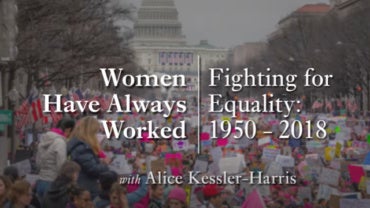
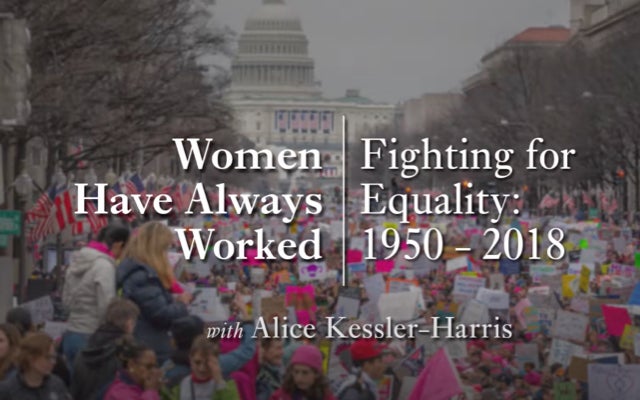
Women Have Always Worked: Fighting for Equality: 1950–2018.
An exploration from an online edX course.

The following are video previews from the edX course “Women Have Always Worked” presented by Alice Kessler-Harris and Columbia University.
Women Have Always Worked: Fighting for Equality: 1950–2018.
An exploration from an online edX course.
In 1820 Lowell, known as East Chelmsford, MA at the time, had a population of 200 and was a farming community. Thirty years later, the population had grown to 33,000 and one could find 32 textile mills in existence there. Lowell was an ideal location for these mills because it was located near the Merrimac River. The river supplied the water necessary to run these factories.
“Culture becomes not a haven of ideas or a fixed state of experience but a social imaginary erupting out of a storied cultural real.” (Stewart 1996, 63-4)
I remember the day when my father, a West Virginia University professor, accompanied some of his students to Charleston for Undergraduate Research Day at the Capitol in February 2018.
Our collections are being digitized and made available through our website, OCLC WorldCat, Internet Archive, Digital Commonwealth, and the Digital Public Library of America (DPLA).
The National Labor Union was founded on August 20, 1866, in Baltimore, Maryland. It was the first attempt to create a national labor group in the United States and one of their first actions was the first national call for Congress to mandate an 8-hour work day.
John L. Lewis was born February 12th 1880, to Welsh immigrant parents in the coal mining camp of Cleveland, Iowa- one mile East of Lucas, Iowa. He began working in the Big Hill Coal Mine in Lucas, IA as a teenager, joining the UMWA Local #799 in 1900. He began his rise to power in the United Mine Workers of America and served as President of the UMWA for forty years and was founder of the Congress of Industrial Organizations.
The Takeaway traces it all back to August 1981, when nearly 13,000 air traffic controllers went on strike creating a standoff with Ronald Reagan that ended when he fired the majority of them and de-certified their union, the Professional Air Traffic Controllers Organization.
The Iowa Labor History Society is a non-profit made up of individuals and affiliate organizations that have joined together to preserve and promote the rich history of Iowa’s workers—the lives, labors, and struggles that shaped the history of our state.