Women Have Always Worked, an edX Course Exploration, 41-50
Video Gallery
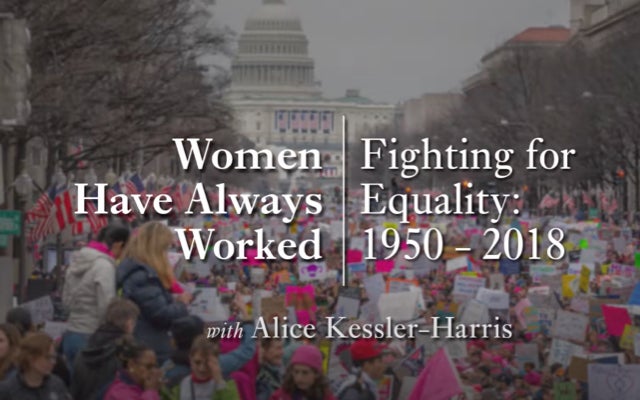
Women Have Always Worked: Fighting for Equality: 1950–2018.
An exploration from an online edX course.

The following are video previews from the edX course “Women Have Always Worked” presented by Alice Kessler-Harris and Columbia University.
Women Have Always Worked: Fighting for Equality: 1950–2018.
An exploration from an online edX course.
The Southern Historical Association was organized on November 2, 1934 with the idea of promoting an “investigative rather than a memorial approach” to southern history. Its objectives are the defense of history education and historical thinking in the South; the promotion of rigorous research in southern history; the collection and preservation of the South’s historical records; and the encouragement of state and local historical societies in the South.
A gallery of photos to explore.
The wildcat Postal strike that began on March 18, 1970 signaled the end of collective begging and the beginning of collective bargaining that raised hundreds of thousands of postal workers, craft and management, from poverty level wages to middle class wage earners.
While studies of the New York City Teachers Union (TU) generally attribute its eventual demise to the Red Scares of the 1940s and 1950s, this article situates the TU in the history of New York City teachers associations more generally.
Women Have Always Worked: Fighting for Equality: 1950–2018.
An exploration from an online edX course.
The Chicago Teachers Union argues for proven educational reforms to dramatically improve education of more than 400,000 students in a district of 675 schools. These reforms are desperately needed and can head Chicago towards the world-class educational system its students deserve.
The first mass work stoppage in the 195-year history of the Postal Service began on March 18, 1970, with a walkout of letter carriers in Brooklyn and Manhattan who were demanding better wages.
The Samuel Gompers Papers collects, annotates, and makes available primary sources of American labor history. Founded by Stuart Kaufman in 1974, the project has published two microfilm series of union records and eleven volumes of Gompers’ papers. The nation’s leading trade unionist in the late…
In 2018, there were 20 major work stoppages involving 485,000 workers, the U.S. Bureau of Labor Statistics reported today. The number of major work stoppages beginning in 2018 was the highest since 2007 (21 major work stoppages). The number of workers involved was the highest since 1986 (533,000 workers).